






Start with the daily habits that support your gut, add targeted support where you need it and give each change enough time to work.
From the trillions of microbes (tiny living bacteria) that live in your gut to the muscles that keep things moving and even the signals that tell you when you’re hungry or full, so much of your digestion follows a daily rhythm, and it responds best to what you do consistently.
That’s why a good gut health routine starts with everyday habits. Supplements can add targeted support where you need it, but when you take more than one, the order matters.
Here’s how to build a routine that fits what you’re dealing with, from the fiber on your plate to which supplement to start with first.
Daily habits that support gut health
Everything you do in a day, from what you eat for breakfast to when you go to bed, sends signals to your digestive system and the microbes that live there. While no single habit changes your gut overnight, together they can set the foundation for everything else in your routine, and even what additional support you may need. These five simple habits are a good place to start, and each one is backed by research.
Eat fiber from a variety of food sources
Fiber is the main food source for the trillions of microbes in your gut, and it comes in different types. The types that feed the beneficial bacteria already living in your gut are called prebiotics, while probiotics are the beneficial microbes themselves. You can get both from food, like onions, garlic, oats and beans for prebiotics, or yogurt, kefir and kimchi for probiotics, as well as from supplements.
Most of us aren’t eating enough fiber to begin with. Guidelines recommend about 14 grams for every 1,000 calories, or roughly 25 grams a day for many women and 38 for many men, yet fewer than 1 in 10 U.S. adults reach that target.1
The variety matters as much as the amount, since different plants feed different microbes.
In the American Gut Project, one of the largest microbiome studies to date, people who ate more than 30 different plant foods a week had more diverse gut microbiomes than people who ate 10 or fewer.2
McDonald et al. (2018). mSystems, 3(3), e00031-18. PMID 29795809. ↗
Fruits, vegetables, whole grains, beans, nuts, seeds, herbs and spices all count. If you’re eating more fiber than you’re used to, build up slowly over a few weeks to give your gut time to adjust and avoid discomfort.
Drink water throughout the day
Fiber needs water to do its job, since water is what keeps stool soft and easy to pass, especially as you add more fiber to your plate.
In a study of adults with constipation, eating more fiber helped people go more often, and the effect was even stronger when they also drank 1.5 to 2 liters of fluid a day, or about six to eight glasses.3
Anti et al. (1998). Hepatogastroenterology, 45(21), 727–732. PMID 9684123. ↗
It’s easier on your gut to sip steadily from morning to evening than to catch up all at once at night, and easier on your sleep, too.
Slow down at meals
When you eat quickly, talk while you chew or drink through a straw, you swallow more air, and that air has to go somewhere, often in the form of gas and occasional bloating. Taking your time and chewing well can help, and so can eating at regular times, since skipping meals can leave you gassier.4
Get light movement after eating
Movement helps keep things moving through your digestive tract, and you don’t need a hard workout to get the benefit. Even light activity helps your body clear gas,5 and in a four-week trial, people who took a slow 10- to 15-minute walk after lunch and dinner reported less fullness and bloating after meals.6
Keep a consistent sleep schedule
Late nights and shifting bedtimes can affect more than your energy. The microbes in your gut follow a daily rhythm tied to when you sleep and eat, and research links disrupted sleep and irregular schedules to changes in the gut microbiome.7
Going to bed and waking up around the same time each day, weekends included, gives your gut a steady rhythm to work with.
When to add a gut health supplement
Even with steady habits, there are times when your gut could use more support, whether that’s the occasional day when things aren’t moving or a diet that keeps coming up short on fiber. Supplements can help fill those gaps, and the most useful ones are built for a specific job. 38TERA’s three formulas were formulated by gastroenterologist Dr. Will Bulsiewicz, each with one clear role.
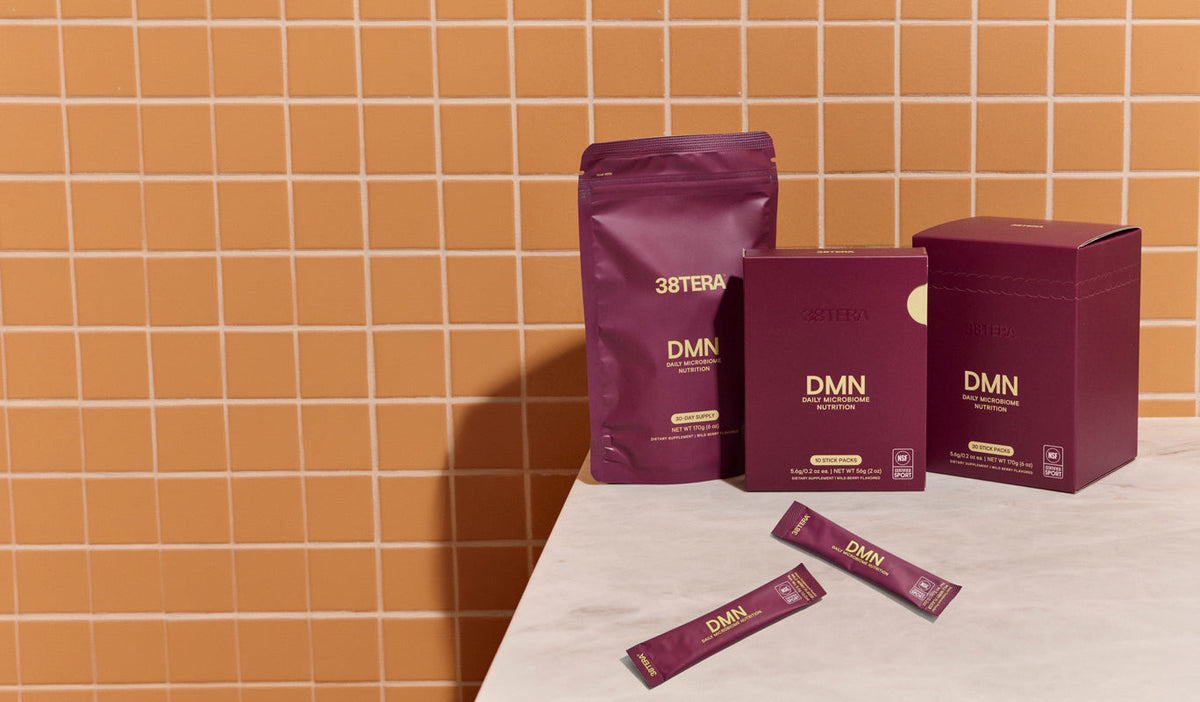
At the center of the routine is Daily Microbiome Nutrition (DMN®), a daily prebiotic designed to stay in your routine long term. It combines three classes of prebiotics, with key ingredients at the doses used in human trials, to nourish beneficial gut bacteria, support regularity and help reduce bloating over time.*
When things aren’t moving the way they should, Regularity & Constipation Ease (RCE™) works three ways at once: magnesium oxide helps soften stool, ginger supports motility and a postbiotic, an inactivated form of beneficial bacteria, supports the gut microbiome.* It helps relieve occasional constipation, with no stimulants and nothing habit-forming.*
Bloating & Digestive Relief (BDR™) is built for occasional bloating after meals, pairing peppermint oil, which helps calm occasional cramping, with ibSium®, a clinically studied probiotic yeast whose benefits build with consistent use.* Together, they help relieve occasional bloating, gas and abdominal discomfort.*
Which supplement should you start with?
The right place to start depends on what you’re noticing most, whether that’s occasional constipation, occasional bloating, a bit of both or simply wanting everyday support for your gut. Adding one product at a time, in the right order, also makes it easier to tell what’s helping.
For occasional constipation
Start with RCE at bedtime, give it about a week and add DMN once things are moving. Adding fiber to a gut that isn’t moving yet tends to increase bloating, so getting regular first lets DMN do its job comfortably.
For occasional bloating
DMN and BDR can start together from day one, with DMN in the morning and BDR with the meals that tend to leave you uncomfortable. Start DMN with a smaller serving and build up gradually, since a little extra gas in the first couple of weeks is a normal sign your gut microbes are adjusting.
For both
When bloating and constipation show up together, getting things moving comes first, since getting regular can ease some of the bloating on its own. Start with RCE, add BDR at the meals that still feel uncomfortable if bloating sticks around after two weeks, and bring in DMN once things are moving. Dr. Bulsiewicz sums up the order this way: move, then relieve, then feed.
Move, then relieve, then feed.
What a gut health routine looks like in a day
Once everything is in place, a full routine fits around the things you already do, from your first glass of water in the morning to winding down at night. Here’s what it can look like with all three formulas, keeping in mind that most people start with one and build from there.
| When | What to do |
|---|---|
| Morning | Stir DMN into water or yogurt, and start the day with a glass of water. A breakfast with some fiber, like oats with berries, gets your plant count going early. |
| At meals | Take BDR with the meals that tend to leave you uncomfortable, and slow down enough to chew well. |
| After eating | Take a 10- to 15-minute walk, especially after lunch or dinner. |
| Throughout the day | Keep sipping water, and work in a few different plants wherever you can. |
| At bedtime | Take RCE with a glass of water, or around dinner if drinking water late keeps you up. Aim to go to bed around the same time each night. |
How long until you feel a difference?
Each formula works on its own timeline, so it helps to know what to expect before you decide whether something’s working. With RCE, many people notice a bowel movement the next morning, feel more regular by day seven and more predictable by day 14, with the full effect by week four.*
BDR’s peppermint oil is the fast-acting half of the formula, and the one you can judge at the meal you take it with. ibSium® builds over weeks of consistent use, with eight weeks as the full run.* DMN works more gradually, so give it four weeks of daily use before you judge it, and know that a little extra gas early on usually settles as your gut adjusts.*
Once things feel steady, you can bring RCE and BDR down to the lowest dose that keeps you comfortable, while DMN stays as your daily foundation. Each product’s guide walks through how to adjust.
Where to go from here
The gut health routine that makes sense for you shouldn’t be complicated. Start with the daily habits that support your gut, add targeted support where you need it, in the right order, and give each change enough time to work. When you’re ready, the DMN, RCE and BDR guides walk through dosing step by step, and our protocols pair the formulas in the order described above.
Common questions about taking gut supplements together
Can I take 38TERA products together?
Yes. 38TERA’s formulas are designed to work on their own or together as part of a comprehensive plan, and none of them interact with each other. If your bloating is mainly driven by constipation, it’s best to get regular with RCE first, since that often eases the bloating on its own.
I’m already taking DMN. Do I need to stop it to start RCE?
No. The advice to start RCE first is for people who are new to both products, so it’s easier to tell what’s doing what. If you’re already settled on DMN and it’s going well, you can add RCE alongside it.
I take magnesium for sleep. Can I take RCE too?
Different forms of magnesium do different jobs. The magnesium oxide in RCE draws water into the colon to soften stool, while forms like glycinate are well absorbed and often used for sleep. Because RCE also contains magnesium, it’s best to check with your doctor before combining it with another magnesium supplement, and a simple blood test can show where your levels stand.
I already take a probiotic. How does it fit in?
A probiotic can be part of a gut health routine, but probiotics vary widely in their strains and the evidence behind them, so there’s no one-size answer. Your healthcare provider can help you decide how yours fits alongside DMN, RCE or BDR.
Do I have to take RCE at bedtime?
Bedtime is recommended so there’s enough RCE working overnight to set up a morning bowel movement, but you have options. If drinking water late keeps you up, you can take it around dinner, and if you’re taking more than two capsules, you can split them, such as two at bedtime and one in the morning.
When should I talk to my doctor about gut symptoms?
Supplements are meant for occasional symptoms, so it’s worth checking in with your doctor if something feels more serious or doesn’t improve.
Reach out if you notice
- Blood in your stool
- Unexplained weight loss
- Ongoing or severe abdominal pain
- Vomiting
- Fever
- Trouble swallowing
- Symptoms that wake you up at night
It’s also time to check in if you need four RCE capsules a day beyond the first week, see no change after four weeks, or notice no meaningful improvement after eight weeks of BDR. If you’re pregnant or breastfeeding, managing a health condition or taking medication, talk to your provider before starting any new supplement.
Key Takeaways
- A gut health routine starts with everyday habits: fiber from a variety of plants, water throughout the day, slower meals, light movement after eating and a consistent sleep schedule.
- Supplements add targeted support where you need it. DMN is the daily foundation, RCE is for occasional constipation and BDR is for occasional bloating.*
- The order matters. For occasional constipation, start with RCE and add DMN once things are moving. For occasional bloating, DMN and BDR can start together. For both: move, then relieve, then feed.
- Add one product at a time and give each one enough time to work before you judge it.
- Check in with your doctor if symptoms feel more serious or don’t improve.
*These statements have not been evaluated by the Food and Drug Administration. These products are not intended to diagnose, treat, cure, or prevent any disease.
Sources
- U.S. Department of Agriculture and U.S. Department of Health and Human Services. Dietary Guidelines for Americans, 2020–2025. https://www.dietaryguidelines.gov; Miketinas D, et al. Usual dietary fiber intake in US adults with diabetes: NHANES 2013–2018. Presented at NUTRITION 2021.
- McDonald D, Hyde E, Debelius JW, et al. American Gut: an Open Platform for Citizen Science Microbiome Research. mSystems. 2018;3(3):e00031-18. PMID 29795809. https://doi.org/10.1128/mSystems.00031-18
- Anti M, Pignataro G, Armuzzi A, et al. Water supplementation enhances the effect of high-fiber diet on stool frequency and laxative consumption in adult patients with functional constipation. Hepatogastroenterology. 1998;45(21):727-32. PMID 9684123. https://pubmed.ncbi.nlm.nih.gov/9684123/
- International Foundation for Gastrointestinal Disorders. Belching: Is it Normal? IFFGD fact sheet 511. https://iffgd.org/symptoms-causes/belching.html
- Villoria A, Serra J, Azpiroz F, Malagelada JR. Physical activity and intestinal gas clearance in patients with bloating. Am J Gastroenterol. 2006;101(11):2552-7. PMID 17029608. https://doi.org/10.1111/j.1572-0241.2006.00873.x
- Hosseini-Asl MK, Taherifard E, Mousavi MR. The effect of a short-term physical activity after meals on gastrointestinal symptoms in individuals with functional abdominal bloating: a randomized clinical trial. Gastroenterol Hepatol Bed Bench. 2021;14(1):59-66. PMID 33868611. https://doi.org/10.22037/ghfbb.v14i1.1976
- Matenchuk BA, Mandhane PJ, Kozyrskyj AL. Sleep, circadian rhythm, and gut microbiota. Sleep Med Rev. 2020;53:101340. PMID 32668369. https://doi.org/10.1016/j.smrv.2020.101340




Leave a comment
This site is protected by hCaptcha and the hCaptcha Privacy Policy and Terms of Service apply.